The Schwanenstein
The Schwanenstein is a large glacial erratic located approximately 100 metres northeast of the harbour of Lohme on the island of Rügen. The boulder lies in the Baltic Sea and is estimated to weigh around 162 tonnes, with a volume of roughly 60 cubic metres. This makes it the fifth largest among the 20 protected glacial erratics found on Rügen. The Schwanenstein also features in the coat of arms of Lohme, a testament to how proudly the local community regards "their" boulder.
The Origins of the Schwanenstein
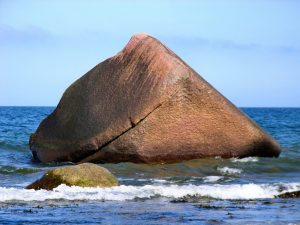 Wikimedia The Schwanenstein is composed of hammer granite, an exceptionally hard variety of granite. Exactly how the boulder came to rest in its current location is not entirely certain, though it is widely believed to have been transported from the island of Bornholm during the last Ice Age. On its western side, the rock features a large crack that has been gradually widening over time. Experts believe that a piece of the boulder may eventually break off, as ice crystals forming within the fissure continue to force the two sections further apart.
Legends Surrounding the Schwanenstein
Like all famous landmarks, the Schwanenstein near Lohme has its share of stories and legends. One tale tells of Adebar the stork, who was said to deliver babies by hiding them in the rock's crevice, from where swans would carry them ashore. A far more tragic story unfolded on 13 February 1956. A group of children were playing along the Baltic coast when the weather suddenly turned. A fierce storm caused the ice the boys were playing on to break apart. Several of them drowned, while three managed to cling to the Schwanenstein for safety. Sadly, all rescue attempts failed. Only the following day, once the storm had subsided, could their bodies be recovered from the rock. In 1995, at the initiative of the children of Lohme, a memorial was placed on their grave.
Practical information
- Address
- Near the harbour of Lohme, north-east Rügen
- Opening hours
- Freely visible from the shore, all year round.
- Price
- Free.
- Visit duration
- Short stop
- Best time
- Best visible from the shore in clear weather and calm seas.
Location on Rügen
Frequently asked questions
What is the Schwanenstein?
A massive erratic boulder in the Baltic Sea, approximately 100 metres north-east of the harbour of Lohme. The stone is estimated to weigh 162 tonnes and has a volume of around 60 cubic metres.
How did the stone get there?
The boulder is a glacial erratic, transported from Scandinavia to Rügen by glaciers during the last Ice Age, much like the white chalk and the many smaller fossils found on the beach.
Can you visit the Schwanenstein?
The stone lies in the sea and is clearly visible from the shore near Lohme. Combine the visit with a walk along the harbour and the nearby chalk coast.
Tickets & tours
Book the best activities, tours and tickets in advance.