Seebad Prora / KDF Prora
In the early 1930s, the German government gave the green light for the construction of a large complex intended to provide recreation for German soldiers serving at the front. The purpose-built holiday resort was designed to accommodate 20,000 working-class vacationers, offering them a place to rest and relax. It was also intended for occasional use as a military hospital. A design competition was held, and several proposals were submitted. Adolf Hitler had a number of favored architects, and the design by Clemens Klotz was ultimately selected. On 2 May 1936, the German Labour Front (DAF) broke ground on the Kraft durch Freude (Strength through Joy) complex. KDF was a subdivision of the state organization DAF.
KDF was a government-run travel organization that made affordable holidays accessible to the working class across various destinations in Germany. Workers who performed well were rewarded with a trip. Through KDF, it was possible to book excursions to concerts, operas, and various day trips. At a later stage, a dedicated cruise ship was even built for KDF (the Wilhelm Gustloff).
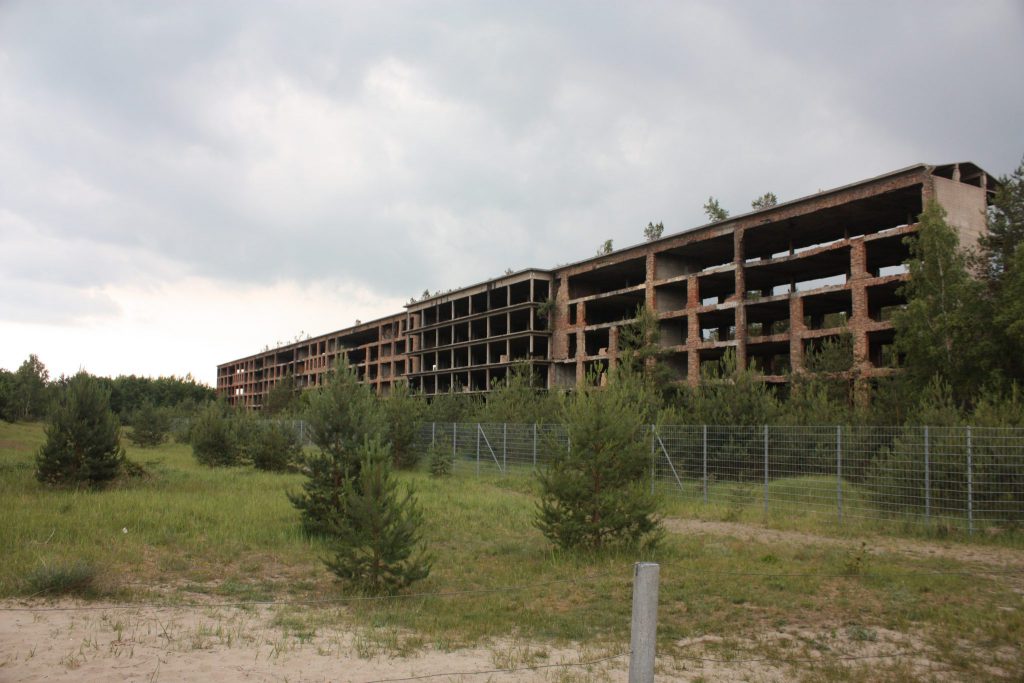
 Architect Klotz designed a complex capable of housing more than 20,000 guests. Every guest was to be treated equally, meaning every room had a sea view. The complex was to consist of four enormous buildings, each approximately 500 metres long, totalling 10,000 double rooms. In addition to the accommodations, a pier was planned between each building, complete with restaurants, two wave pools, a theatre, a cinema, and a banquet hall for more than 25,000 visitors. All 10,000 rooms in the complex were identical in size, measuring 5 by 2.5 metres. Each room was equipped with beds, a seating area, and a washbasin. Showers and toilets were located in the wing sections, which also housed the staircases. All major German companies were involved in the construction of this immense complex. The goals of the DAF and KDF were straightforward: the complex was to be ready for use by 1940.
Photos of Prora (article continues below)
When World War II broke out in 1939, construction on the complex was halted. At that point, eight blocks, one theatre, and the quayside had been completed in their raw structural form. After the war began, prisoners were put to work completing various buildings. The vast complex stretches nearly 4.5 kilometres in length, and from the water the rooftops of the buildings are clearly visible, giving a strong sense of just how large the complex was - and still is. Aerial photographs of the site are also well worth looking at, as they provide an equally impressive impression of the scale. After the war, the Red Army took up residence in the buildings, using them as barracks. Attempts were made during this period to demolish the structure, but the sheer amount of explosives required made this impractical, and the demolition work was eventually abandoned. One particularly striking fact about Prora is that it was never used for the purpose it was built for. The total budget for the complex was never officially disclosed - initial estimates suggested around 35 million Deutsche Marks, though the actual cost was likely closer to 200 million Deutsche Marks. The exact figures have never been made public.
PRORA TODAY
The future of the Prora complex remains uncertain. Numerous plans have been proposed and are awaiting approval, including hotels, schools, museums, and nightclubs. To this day, no definitive direction has been established. It is possible to walk along the various buildings, which is certainly worth doing. Two museums are also located in and around the site. Guided tours are available as well, during which a guide provides extensive background information about the buildings and their history.
Practical information
- Address
- Dokumentationszentrum Prora, Prora, 18609 Binz
- Opening hours
- May to Aug 9:30-19:00, Mar/Apr and Sep/Oct 10:00-18:00, Feb 10:00-17:00, Nov/Jan 10:00-16:00. Guided tours (DE) daily at 11:15 and 14:00 during peak season.
- Price
- Adults €7, concessions €3, family ticket €15, children under 12 free.
- Visit duration
- Approximately 2 hours
- Best time
- Combine your visit with a walk along the beach; Prora's beach is wide and peaceful.
- Website
- www.proradok.de
Location on Rügen
Photos
Frequently asked questions
What is Prora, the Koloss von Rügen?
Prora is an almost 4.5-kilometre-long seaside resort complex built between 1936 and 1939 under the Nazi regime through the Kraft durch Freude (KdF) organisation. It was designed to accommodate 20,000 holidaymakers at a time, but was never completed as a resort.
Can you visit Prora?
Yes. You can walk freely along the buildings, and there is a Dokumentationszentrum that presents the site's history. During peak season, guided tours are offered daily; tours in Dutch or English can be arranged on request.
How much does the Dokumentationszentrum cost?
Adults pay €7, the concession rate is €3, a family ticket costs €15, and children under 12 enter free of charge.
Is Prora still in use today?
Parts of the complex have been renovated in recent years into holiday apartments, a hotel, and one of the largest youth hostels in Europe. Other blocks still stand in their unfinished state, which is precisely what makes the site so remarkable.
Nearby
Tickets & tours
Book the best activities, tours and tickets in advance.